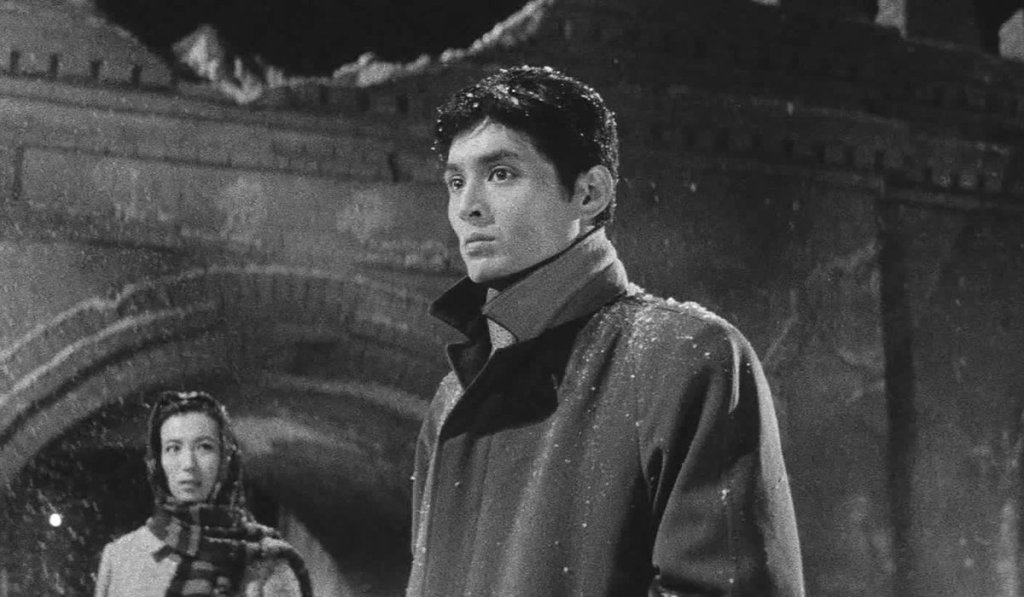
Between the years 1959 to 1961, Masaki Kobayashi adapted the six-volume novel by Jumpei Gomikawa called “The Human Condition” (人間の條件, Ningen no jōken). A trilogy set during the heights of World War 2 at the Japanese-occupied Manchuria, we see the horrifying world that lives in the shadows of the now entertainment-rich and peace-loving Japan. Our protagonist is the young Kaji, who is anything but an apologist of the atrocities Imperial Japan committed. Trying to avoid being drafted into the war out of love for his girlfriend, Kaji takes up a job as a labor supervisor in the occupied Manchuria. As an idealist stuck in a system that thrives on ethnocentrism, despotism, and misogyny, Kaji is a malfunctioning cog in the machine. His utopian thought fueled by socialist ideas, pave the way to fighting this imperial system from labor camps to the very frontlines of war. Kaji is also given depth as a character whose obsession with what is right is questioned throughout his journey. His idealism is met with hindrances along the way and his mental anguish grows as a result of his failure to help the people around him.
As a man living with liberal views under an authoritarian regime, Kaji is ostracized for sympathizing with the Chinese POW. He is ridiculed for his humanist perspective and criticized for suggesting ethical treatment for the Chinese workers. Although his heart stayed true to them, he was seen as a Japanese and a liar for failing to provide for them. Due to him lacking any actual executive power in the mine, Kaji’s promises are thwarted by the army and therefore no true trust in him was established. Till the end, he was seen as a scapegoat and although he does openly protest against the public execution against the POW, he is arrested as a co-conspirator for his acts of defiance and his collection of liberal books. He is then drafted into war, a fate worse than death to him. Even as a soldier who arguably was the best in his unit, he is rebuked for taking care of his unit and mocked as a traitor. Later he is sent into the frontlines with his team during the Soviet Invasion in which nearly everyone is wiped out and Kaji faces his first major mental anguish as he unintentionally chokes his fellow soldier to death. Barely surviving with a few survivors of his unit, he traverses through a jungle and takes with him a group of stranded people to lead them to safety who then died from starvation or poisoning themselves with wild mushrooms due to Kaji refusing to distribute extra rations. His hopes to see his wife, Michiko, kept manifesting as hallucinations as he met various women along the way and it fueled his determination to cross the long route back to her. Although still a man with dignified morals, Kaji now sees his role as a soldier before an idealist and he refused to surrender. He does ultimately surrender to the Soviets to prevent any bloodshed of his surviving unit and is greeted with hardships as the Soviet-run factory lacked any ethical treatment of their Japanese POW factory workers. Kaji ultimately loses his grip in reality as his protégé, Terada, is brutally overworked to death. Kaji kills Kirihara the collaborating officer responsible for his demise and escapes the camp. Walking along the cold regions of South Manchuria, Kaji loses all his willpower and ends up as a beggar that is berated by the Chinese as a “Japanese Devil”. With Michiko’s ominous laughter echoing through his head, Kaji continues his aimless pursuit to be returned back to Michiko and eventually succumbs to the cold and dies.
Kaji is a character that I see to be doomed from the beginning. Although I did believe there were moments Kaji would succeed in escaping, I do see why the trilogy began from a high ground of optimism till it fell into a question of nihilism. All the deaths he witnessed were all mental anguishes that slowly broke his willpower to fight against the wrongs of the world and as he rode the “humanism train”, eventually it all bit him at his Achilles’ heel – his utopian thoughts rejecting him. The first movie indicates his fanatic obsession with his ideologies and his dismay at being recognized as a Japanese (actions taken by the army further blurred the lines of his individuality from the rest). But by the third film, Kaji recognizes himself as a Japanese, as an enemy of both the Chinese and the Soviets. In war, either you’re the enemy or you’re not, there is absolutely no in-between and this goes well with Kaji’s situation as he kept trying to rationalize with the enemy which ironically drew an even bigger line between both parties. Kaji treated war as not a battlefield but a fight of what is right and what it is wrong to persevere through and he lacked the situational awareness of what is actually at play. This is where Kaji misplaced his idealism in the very place where the human rationale is non-existent and a kill-or-to-be-killed idea running through everyone’s head. Kaji‘s pacifist self is questioned throughout the films and it’s at the very frontlines where the horrors of war first get to him. Quoting Kaji, “I’m a monster, but I’m still alive!“.
To add a bit more context to his character, Kaji was not a foolish man. His idealism was empowered each step of the way and although he did meet a cruel fate, he stood strong as a testament of goodwill against all evildoers. He was separated from the rest for always carrying a very conscious sense of the world around him and while everyone else accepted the end of their fates in the nether realms of Manchuria, Kaji’s sought after a utopia till the very end – back home. It should also be noted that while Kaji was going back to his beloved, he was accompanied by others that too wanted to get back with their families and they all met a cruel demise. Even in all of this, Kaji’s moral ground was never questioned as he went through each conflict in his journey and although his spirit died with the realization of being rejected at where an eternity of hope awaited him, he walked till his last breathe and died as a man with determination. He died with the love for his wife even if it meant it’d be the end of his life. Michiko acts as an argument to further support the notion of his idealistic behavior as his almost fanatic obsession of going back to her refers back to the dedication and unwavering hopes he had shown in the first film (hence the title, No Greater Love). Kaji’s plight as he desperately clung to the hope for her survival shows the extent he went without any guarantee of her being alive despite all the deaths around him.
I do see how the title, The Human Condition, is being reflected through Kaji. As an anti-war film, it greatly uses human psychology as an argument against war. Breaking down a person’s willpower surely encompasses the mass audience to an idea of existentialism and how the idea of war is romanticized in most literary media in contrast to Masaki Kobayashi’s work. Most war films showcase the brutality of war by showing the losing side, meanwhile, Masaki Kobayashi focuses on breaks into the strengths of Kaji, and by sprinkling hope to his journey, it all ends in a tragic yet powerful way. Kaji’s life as a man forced to be drafted into a fight he never wanted to be a part of and losing everything he had as a result of it shows how war never discriminates whose life it takes and ultimately it’s a fight to survive than a fight of morality.

 ThinkAppend
Leave a comment