
A Brighter Summer Day (牯嶺街少年殺人事件 literally meaning The Homicide Incident of the Youth on Guling Street), directed by Edward Yang, is a film that is centered between the late 1950s and the early 1960s in Taipei, Taiwan. Taiwan at the time was occupied by the military when Communism took over China. People migrated to Taiwan and brought in a new generation lost in a world that was a microcosm of their parents’ old lives. Children would turn to delinquency in an effort to curb away all the pent up thoughts of alienation that would grant them the mirage of security. This momentary sense of power through violence was equally challenged by the immersing of pop culture through icons such as Elvis which create a polarity between the two sides. In all of this, it is clear to see that the youth desperately looked for ways to empower their identity in a place where no sense of identity ever existed.

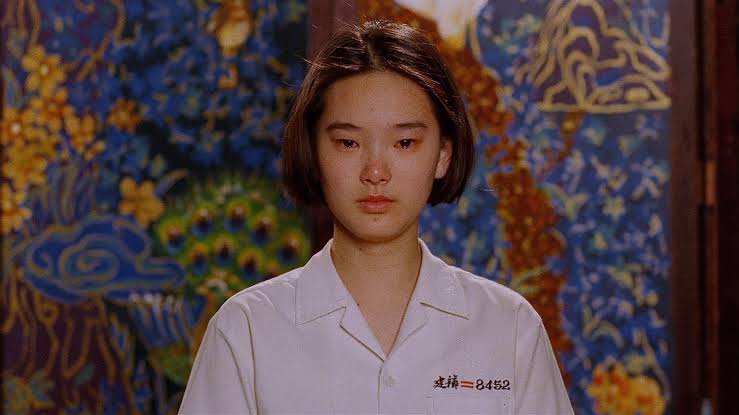
Edward Yang wrote a love letter to the era he fondly remembered through A Brighter Summer Day. From recreating the environment using vibrant colors to bringing in wannabe James Deans of that era, Yang did not miss a single detail replicating his teenage world to show the audience what life looked like back then. Yang’s intricate use of cinematography combined with the use of vibrant colors, created a mystical feeling of familiarity and that is proof of Yang’s incredible directorship. The main trick that allured the audience into syncing with each character would arguably be the lonely environment that was crafted through the characters with their awkward or angsty personalities which were fitting for teenagers trying to fit in. These characters would also receive dynamics that given the film’s 238 minute duration, is indeed very steadily explored.
As mentioned earlier, the era Yang wanted to showcase to his audience, suffered a lack of a collective identity. Characters such as Xiao Si’r, Cat and Ming have a longing to understand themselves as society clearly didn’t provide a template for them to work on. Cat’s obsession with Elvis is his personal quest to find meaning in his life as his short, skinny stature hindered him from partaking gang activities. Through music, Cat was finding what he can do even if it meant he didn’t completely understand what it meant to him. Xiao Si’r’s sister once asked Cat the point of singing English songs if he can’t even speak English, proving his obsession with Elvis to be a manifestation of his longing to set himself apart even if it meant him singing words he couldn’t understand. This blind obsession is also recurring with Xiao Si’r and Ming: both wanting to love or be loved. Ming’s automated behavior to move forward is lax compared to the more stoic Xiao Si’r. Ming’s philosophy was her belief that she cannot be changed and she is as she is. This contrasted Xiao Si’r’s belief that he could change her and his belief was birthed by his fixation on Ming. His almost parasitical attachment to Ming can be drawn out from the last bit of Are You Lonesome Tonight by Elvis, a song the movie references multiple times:
Honey, you lied when you said you loved me
And I had no cause to doubt you
But I’d rather go on hearing your lies
Than go on living without you
Now the stage is bare and I’m standing there
With emptiness all around
And if you won’t come back to me
Then make them bring the curtain down – Elvis (Are You Lonesome Tonight)
These lines foreshadow Xiao Si’r and Ming’s relationship and in ways, the ending. The first lines indicate Ming’s nature of independently making her own decisions which involved her way of being around people that did not treat her well. Her friendship with Xiao Si’ir caused Xiao Si’ir to become attached to her romantically. Xiao Si’ir accepted her lies until the very unfortunate climax. The lines where it refers to a stage also seem to refer to Xiao Si’ir’s lonely high school life and the curtains seem to be a symbolic representation of his fate at the end of being jailed for Ming’s murder. It is worth noting that in the end when Xiao Si’ir stabbed Ming, it looked like a hug. This shows how twisted Xiao Si’ir’s idea of love became. The love he saw was nurtured through violence, greed, and vanity that he grew curious about which made him develop in the latter half of the film to became more rebellious, something that was seen as desperation for solving a personal identity problem back in that era. This angsty character development wasn’t void of irrationality on his part but rather his way of holding onto the train of life, something most characters were doing as well. In the end, it ended in a jaw-dropping turn of events which in retrospect, is a great way to end a film that was centered on the era of multitudes of identity. This final act of “love” is Yang’s way of making the audience understand that Ming’s death was beyond a typical murder driven by jealousy, it defined an era for him. It s also worth noting how much Taipei’s society eroded Xiao Si’ir’s mind that drove him to break down his previous monotonous behavior as the first humane emotion that the audience sees is him yelling at Ming at the end. A narrative epic with the subtlety of tragedy, Yang’s motive seemed to be using the murder incident to define an era full of complexities.
It saddens me a lot that people do not realize the greatness of A Brighter Summer Day. This film remains one of the closest to my heart and I hope to write an extensive review on this in the near future. I sincerely hope everyone that reads this watches this beautiful film and grasps the magic that bewitches anyone that watches Edward Yang’s magnum opus.
I must commend Criterion for restoring this terrific film (you will not believe the differences the original version and the restored version have). I highly recommend you check out Criterion’s official website for more details as I certainly learned a few facts about this film I was previously unaware of.

 ThinkAppend
Leave a comment