Note: This review focuses solely on the anime. Differences in the manga could be very likely. I will also not spoil anyone more than the first 4 episodes as Monster is an anime best enjoyed by not knowing what is to come and I loved the fact that I enjoyed it to its fullest.
Naoki Urasawa’s Monster is a splendor work in the history of anime. An anime set mostly in post-war Germany during the late 90s, both the manga and anime are arguably what gave rise to the great Naoki Urasawa’s popularity on an international scale, and rightfully so. Monster is a timeless psychological thriller masterpiece that can easily be argued to age like fine wine as most anime continue to narrow down to a formula that is reminiscent of most today. With a total of 74 episodes, Monster does not bore the audience in the least bit and the tension it draws by adding a bit of lore nearly every episode is a maze of speculation that fortunately does not leave any major plot holes by the end. The art direction of the anime is also very unique and can appeal to both a younger and older audience. The best part of the anime, of course, is the very story itself.
The main character is a well-renowned Japanese neurosurgeon, Dr. Kenzo Tenma. At the very beginning of the story, Tenma is rebuked by a Turkish woman as he ended up operating on an opera singer instead of her husband who was brought into the emergency room earlier. Eva Heinemann, the daughter of Director Heinemann and Tenma’s fiancee, also tells him that not everyone’s lives are created equal which leads him to question the ethics of the hospital.
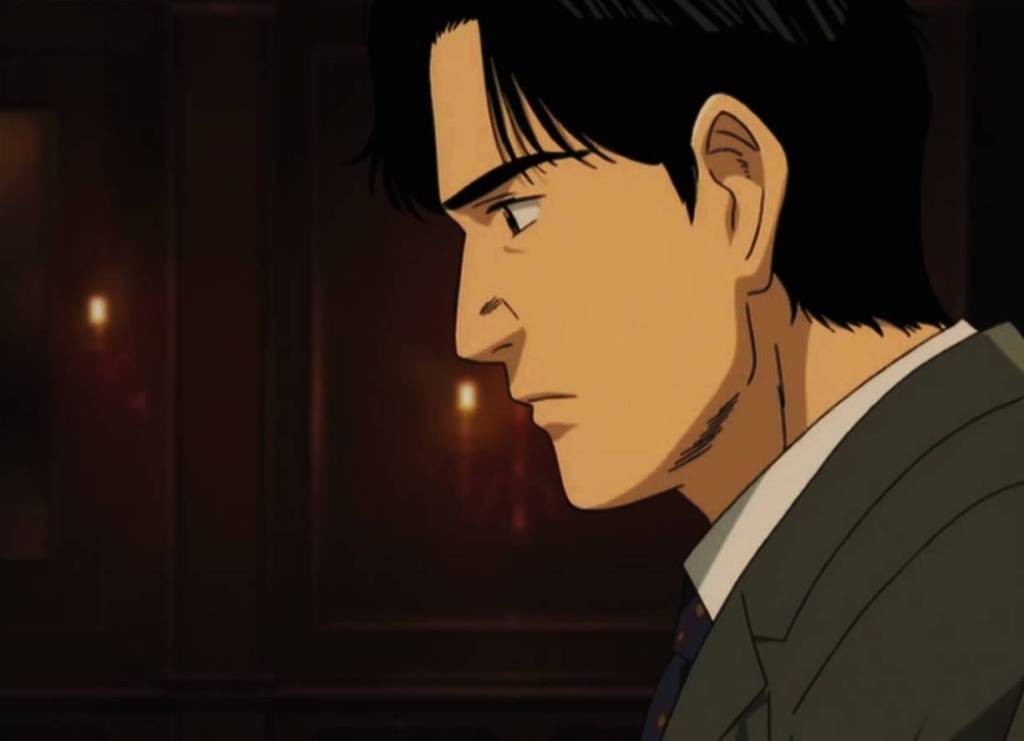
(Sorry for the low resolution pictures!)
Soon afterward, two kids are rushed into Eisler Memorial Hospital in the middle of the night. They are twins and one of them, Johan Liebert, was shot in the head by an unknown assailant. As Tenma prepares to conduct a risky operation to save the boy’s life, he is ordered to operate on the town mayor instead of the boy. Tenma refuses to do the latter and ends up operating on the boy and although the mayor dies in surgery conducted by other surgeons, Tenma successfully extracts the bullet lodged deep into Johan’s head. Tenma is then berated by Director Heinemann for costing the hospital’s reputation and demotes Tenma. Eva breaks off their engagement as Tenma now no longer provides her any superior social status and ridicules Tenma’s belief in the love they had for each other being genuine. Tenma then goes to visit Johan in the hospital unaware he is now conscious. He angrily wishes that those who costed his career would be better off dead and is startled by his dark confession and hopes no one heard it. A few days later however it is found out that Director Heinemann along with Dr. Boyer and Dr. Oppenheim is found dead. Reportedly they consumed candy laced with a muscle relaxant. Tenma is brought into questioning by a federal criminal police office in Germany, the BKA. Inspector Lunge, an officer of the BKA, questions Tenma regarding his involvement in the case. Deeming it as a tragedy that seems to benefit only one man that is Tenma, Lunge places Tenma as his main suspect in the foul play. During all of this, the twins escape and are nowhere to be found. The case is soon dismissed for years and Tenma is promoted to Chief Of Surgery.
9 years later, Tenma is still a surgeon in Eisler Memorial Hospital. He is brought a lock-picker, Adolph Junkers, who was hit by a car while running away in fear. Soon he encounters Lunge who is now investigating the man connected to a series of murders of middle-aged couples. Tenma successfully saves Adolph Junkers and visits him. While trying to communicate with an incapacitated man, he tells Tenma that “the monster is coming“. Lunge then proceeds to question him regarding his involvement in the murders only to drive the man into a hysteric fit. Later Tenma bonds with Junkers and finds out Junkers wanting a clock with a nutcracker that would pop out from the clock when he was young. Tenma buys a similar clock for Junkers and heads to the hospital to give it to him.
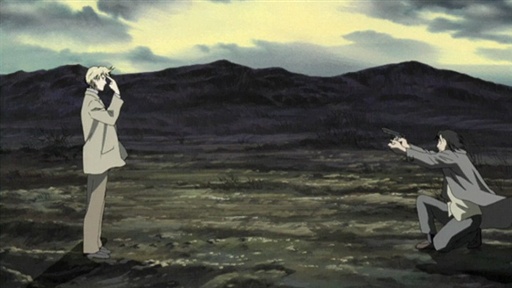
However, Tenma finds that the guard that was hired by Lunge to protect Junkers was poisoned by the very same candy found 9 years ago and rushes out of the hospital to pursue Junkers to a nearby construction site. There, Tenma finds Junkers with a young man who thanks Tenma for saving his life 9 years ago who Tenma recognizes to be Johan. Johan tells Tenma that this is execution and points his gun towards Junkers. Junkers pleads with Tenma to run away and confesses to Tenma that the series of murders were ordered by Johan and that Johan killed Junkers’ crew. Tenma tries to reason with Johan to not kill Junkers only for Johan to tell Tenma that Johan is not his real name and that his past should not be known to anyone. Johan, expressing his gratitude to Tenma for saving his life, tells him that he is like a father to him. Tenma argues that he found meaning in saving lives due to Johan with Johan remarking that he is glad he helped Tenma get promoted to Chief Of Surgery by killing his superiors. Shocked, Tenma can do nothing but watch the monster as he mercilessly shoots Junkers.
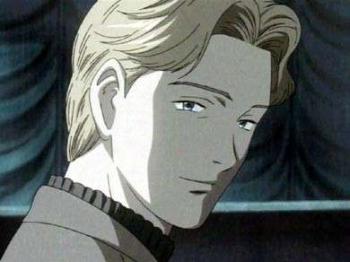
Monster has satiated my hunger for an anime that would test my views constantly. Due to having a powerful theme of duality that surfaces through a multitude of characters, the anime does not feel exhausting and every character gets the proper treatment they deserve. It owes a great deal of development to the characters and certainly has the audience on the edge of their seats with cliffhangers in almost every episode. The story also delves deep into Johan Liebert’s psyche which is rich in psychoanalysis and brings justice to his character. By making Johan multifaceted, his character gets a well-paced development throughout the anime with a satisfying conclusion to his character arc that is best left unsaid for now.
The ethical dilemma of killing one life to save more is explored to its deepest layer. Tenma’s moral conscience brings in a disorder in the world as Tenma saved a life that created a cycle of deaths that would have been avoided had Tenma not saved Johan in the first place. Tenma vowing to kill the monster he saved, is a powerful contradictory idea in the anime that finds a doctor who wishes to save lives by killing one individual. From an existential point of view, it is subjective that it would align with moral conscience. If Tenma does indeed take Johan’s life, he too will be no different than Johan and he becomes what he is framed to be. This shows how Johan brings a stain both in his and his potential murderer’s hands. Although he is a killer, he is also the very same boy that gave Tenma the purpose to save lives. This taints this very purpose and is left to Tenma to carry out what he best believes in.
It also brings a bunch of World War 2 elements which is not surprising considering how the setting of Germany in Monster is layered with several references to the socioeconomic state post-war. It also did a good job highlighting Czechoslovakia as one of the central points in the story and the incorporation of the secret police is something I greatly admired as a major element in the anime. The socioeconomic divide between East Germany and West Germany is also subtly explored which pays a great contribution to a history that is often forgotten. Some elements to the story parallel real-life horrifying experimentations done during World War 2 that makes the anime a great medium to educate people.
I am thinking of reading some of Naoki Urasawa’s other great works as Monster left an everlasting impression on me. Initially, I wanted to work on character analysis for each major character in the anime but I opted for writing a brief article to spread the word for this majestic piece of art. I hope you start watching Naoki Urasawa’s Monster as this is the one psychological thriller anime that I think you are longing for as well.
 ThinkAppend
Leave a comment